I am writing this blog to share my experiences with my Cancers, Weight Issues, and Surgeries over the last few years. Hopefully it will help some of you, as well as making me feel better while sharing. You will also see what is on my mind when I just feel like sharing or ranting. Sometimes I will share items from our store.
What a day! We went to the oncologist today to get the results of the PET, blood work, and hear the plan for attacking my cancer, Dr Faria (the oncologist) said they found a 1.9CM tumor in my right lung and they can;t (or better yet) won't start the chemo till after they find out about the tumor. So. I;m going in the hospital tomorrow morning for a biopsy on the lung tumor and have the chemo port installed. Hopefully, I'll be able to come home in the afternoon. He should get the biopsi results the first of the week, and I'll start chemo on October 10th. They are going to determine what to do about the lung tumor. I will be on a fusion pump that I will need to carry around.. I guess I'l just wait and have to see how it goes as well as the biopsy/
Ally's infection is getting better. She is now home and has an open wound so it can breath and heal. They painted a "Smiley Face" on her abdoman and told her that if any of the redness or inffection spreads beond that line she will have to have immediate surgery. We're still praying for her!
Please check out our web store. We're selling out of Baby Stollers like mad. Check them out yourself at www.stuffnthingscorp.com
Seems like it is one thing after another around here. Our grandaughter was just taken to the ER and diagnosed with MRSA. She has a terrible infection that seems to have spread into her belly button. So far, all we know is that they are going to cut into it for treatment. I didn't even know what it is. It is a very sever type of Staph Infection. Here is information on it from WebMD.
Methicillin-resistant Staphylococcus aureus (MRSA) is a bacterium that causes infections in different parts of the body. It's tougher to treat than most strains of staphylococcus aureus -- or staph -- because it's resistant to some commonly used antibiotics.
The symptoms of MRSA depend on where you're infected. Most often, it causes mild infections on the skin, causing sores or boils. But it can also cause more serious skin infections or infect surgical wounds, the bloodstream, the lungs, or the urinary tract.
Though most MRSA infections aren't serious, some can be life-threatening. Many public health experts are alarmed by the spread of tough strains of MRSA. Because it's hard to treat, MRSA is sometimes called a "super bug."
Garden-variety staph are common bacteria that can live on our bodies. Plenty of healthy people carry staph without being infected by it. In fact, 25%-30% of us have staph bacteria in our noses.
But staph can be a problem if it manages to get into the body, often through a cut. Once there, it can cause an infection. Staph is one of the most common causes of skin infections in the U.S. Usually, these are minor and don't need special treatment. Less often, staph can cause serious problems like infected wounds or pneumonia.
Staph can usually be treated with antibiotics. But over the decades, some strains of staph -- like MRSA -- have become resistant to antibiotics that once destroyed it. MRSA was first discovered in 1961. It's now resistant to methicillin, amoxicillin, penicillin, oxacillin, and many other antibiotics.
While some antibiotics still work, MRSA is constantly adapting. Researchers developing new antibiotics are having a tough time keeping up.
Who Gets MRSA?
MRSA is spread by contact. So you could get MRSA by touching another person who has it on the skin. Or you could get it by touching objects that have the bacteria on them. MRSA is carried, or "colonized," by about 1% of the population, although most of them aren't infected.
MRSA infections are common among people who have weak immune systems and are in hospitals, nursing homes, and other heath care centers. Infections can appear around surgical wounds or invasive devices, like catheters or implanted feeding tubes. Rates of infection in hospitals, especially intensive care units, are rising throughout the world. In U.S. hospitals, MRSA causes more than 60% of staph infections.
Community-Associated MRSA (CA-MRSA)
But MRSA is also showing up in healthy people who have not been living in the hospital. This type of MRSA is called community-associated MRSA, or CA-MRSA. The CDC reports that in 2007, 14% of people with MRSA infections had CA-MRSA.
Studies have shown that rates of CA-MRSA infection are growing fast. One study of children in south Texas found that cases of CA-MRSA had a 14-fold increase between 1999 and 2001.
CA-MRSA skin infections have been identified among certain populations that share close quarters or experience more skin-to-skin contact. Examples are team athletes, military recruits, and prison inmates. However, more and more CA-MRSA infections are being seen in the general community as well, especially in certain geographic regions.
It's also infecting much younger people. In a study of Minnesotans published in The Journal of the American Medical Association, the average age of people with MRSA in a hospital or health care facility was 68. But the average age of a person with CA-MRSA was only 23.
Well this is a bit late but wanted to share my experience. I was diagnosed with colon cancer after receiving a colonoscopy in late January. They scheduled a resection operation in February to remove the canerous area. I was still having terrible fluid retention problems, so I had to get clearance from a cardiologist and pulmanologist. They said I only had a 10% chance of making it through surgery if I didn't have open heart surgery first. My heart was only working at 15 to 20% of capacity so the surgery had to be done immediately. I had gained 70 pounds in the previous six weeks. All the doctors got together to see if they could actually do the surgery. The heart surgeon said he could fix the problems but didn't know if I could make it through the surgery. There was a great bit of discussion as to whether or not to go ahead or if my chances were so low that I wouldn't make it. After much debate and drama, they transferred me to NW Regional Medical Center where they have a heart center. They did a double bypass and repaired 2 valves. To make a long story short I obviously made it. However, I started having chest pains again about 3 weeks after surgery. They rushed me to the hospital for a catherazation and found that I have another bad artery. My heart is now operating at about 40 to 50%.
At six weeks they felt I was strong enough to have the bowel resection and did it September 2nd. The surgeon said he found about 5 inches of obvious cancer and removed about 18 inches of colon. He also removed 26 lymph nodes. The tissue went to pathology for analysis. The report came back showing the cancer had spread beyond the colon, and was found in 20 of the 26 samples, as well as the colon itself. They set the diagnoses as stage 3c cancer. Research says stage 3C has about a 40% chance of a five year survival. I went to an oncologist and he sent me for a PET scan and told me I had to have chemo. he said "not having chemo was just plain suicide". They are going to put in a "port" for the chemo. I will have to have at least six months of it. He got the results last Wednesday and I got a call from a hospital for pre-admittance the next day. I asked what for and they said it was for the port. then I got a call from a home nursing agency attempting to set up an appointment to come here to the house to start a 48 hour chemo pump. I didn't know anything about any of this. When I was at the oncologist, he said he would have a treatment plan ready for me, and we would discuss it when I came back in a week. I'm supposed to go see him this Wednesday (9/28) to discuss it. The PET scan showed the cancer spreading so he was going to start me with the 48 hour treatment before starting the regular chemo treatments. He didn't tell his scheduling department that I was taking coumadin (blood thinner) and they had to reschedule the port procedure. Now the doctors are arguing about who is going to do the procedure. Such drama!! My regular surgeon (Dr Paul Wizman) is absolutely wonderful, knows me well and really cares. He has done 3 operations on me and has been involved with all my medical issues for the last 3 years. I am a person to him, not just another patient!!! That is very hard to find down here in south Florida. So, at this point, I will be going to the oncologist Wednesday, have to port installed Thursday and the chemo home pump attached and started Friday.
As you can imagine, this is all very intense, scary and nerve racking!
I wake up feeling good but by around 3pm I get weak and tired. The chemo is just going to make that worse. I'm nervous and anxious to know what he is going to tell me on Wednesday. I'll let you know.
I found this article very inspiring. I am going to be posting about my cancer and successes and failures. I am going to the oncologist today to discuss my situation and treatment alternatives. I am attempting to be very positive and am reading a lot of different articles related to cancer types, stages, potential cures and such. I think this article is a good start and will help me keep a positive attitude.
When my wife, Chris, was in the middle of her chemo treatments, a woman came to our table in a restaurant and said that she, too, had gone through chemo and wanted to know how Chris was doing. Chris had been approached before, but there was something different about this woman’s demeanor. It soon became apparent what it was that was different.
“Look at my hair,” she said with enthusiasm; pointing to her long, thick, black locks. “It came back with a vengeance! It’s curly now and I just love it!”
Then came the pearl: “My treatments and chemo were hard, but now it’s over and I barely remember it. It’s amazing how quickly you forget the bad stuff.”
At the time, this was very comforting to hear because when you’re in the middle of it, it seems like it will never end. Here was reassurance from someone who had been there; she did not minimize the difficulty but rather acknowledged it, and then assured us that when it was over she would forget a lot of it.
She was right.
Even though Chris is nine years out, we certainly remember that she went through chemotherapy (twice, now, as it turned out) but the memories of the unpleasant part of it have indeed faded. We can recall the treatments, the nurses, what was said, what we did, the driving to and from treatments, etc., but the side effects and discomfort are both a distant memory.
Here’s the best part: We didn’t have to do any work or anything special for this to happen! I guess it’s just human nature, sort of like the pain of childbirth. I don’t have any personal experience with this, because neither Chris nor I have ever actually given birth, but we have it on good authority that it is a pain that is quickly forgotten.
Although the reasons for this are different than the reasons we forget about the unpleasantness of treatment, I’m going to stick with the analogy. With childbirth, it is the joy of the result that causes you to forget the pain. With treatments, it is the joy and sense of accomplishment when it is over.
What I’m saying here is to take heart that, although it is discouraging and difficult to go through your treatments, you WILL come out the other side and forget the bad stuff.
Our restaurant friend did. Chris did. You will, too.
Shameless plug: We have a lot of great Things on our website, and any sales will help us with upcoming medical expenses.
It's been a while since I've posted anything here. I've been busy with health issues, but am now healing and getting back to Normal, whatever that is ;) I am going to write about my adventure in the medical field this past week in another post later today or tomorrow.
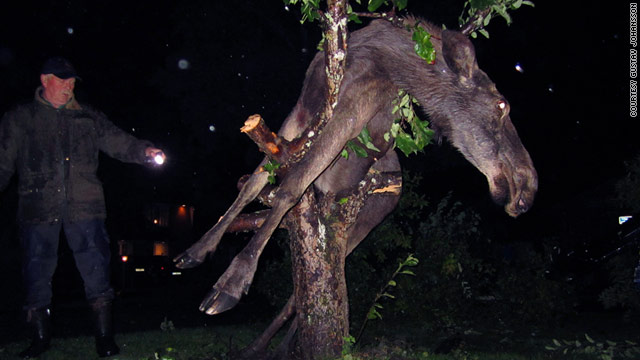
I like reading the bizarre and unusual news and thought I'd repost this article I picked up. You need to be careful with those darn Swedish Apples. So, be careful what you eat!
A moose got stuck in a tree after eating fermented apples in Saro, Sweden, Wednesday night.
STORY HIGHLIGHTS
"I saw something really big up in a tree," Per Johansson says, "and it was a moose"
A rescue team uses a winch to bring the moose down
Fermenting apples led to intoxication, a rescue official says
(CNN) -- It was a dark, windy and rainy night when Per Johansson returned from work to his home in Saro just south of Gothenburg, Sweden.
"It was raining really bad. In the wind I heard something screaming with a very dark voice," Johansson told CNN. "At first I wondered if it was the crazy neighbors, but then I heard it again and went and checked. I saw something really big up in a tree in my neighbors' yard and it was a moose. It must have been drunk after eating fermented apples and as it was reaching out for more fruit it must have slipped and fallen into the tree."
Johansson called the local fire and rescue department, which responded with a fire engine and a jeep with a winch.
"We got the alarm at 9.59 p.m. on September 6 that a moose was stuck in a tree," said Anders Gardhagen, spokesman at the Gothenburg Fire and Rescue Services.
"When we arrived we used the winch to bend down the apple tree so the moose could get himself out of the tree. Once free, the moose collapsed on the ground and fell asleep. So we let him sleep it off and went back home" Gardhagen told CNN.
"Moose are attracted by the apple trees, and in the autumn when the apples have fallen off the trees we normally have at least one of these cases of intoxication. These apples, which ferment in their bellies, aren't part of their natural food, so they can get quite angry from this drunkenness," Gardhagen said.
Johansson's son, Gustav, who is about to turn 11, made sure to take lots of pictures of the ordeal.
"He is saving up to buy a PlayStation so he thought he would take pictures that he could sell," Johansson said.
CNN purchased three of Gustav's pictures.
When dawn came the day after it was freed from the tree, the moose had not yet left.
"When I went out for the newspaper it was still laying there on the ground, sleeping. By the time I left for work it was walking around the neighbor's yard on very shaky legs." Johansson said.
"Today the moose came back and walked around the yard," he added. "I think it likes it here."

 What a day! We went to the oncologist today to get the results of the PET, blood work, and hear the plan for attacking my cancer, Dr Faria (the oncologist) said they found a 1.9CM tumor in my right lung and they can;t (or better yet) won't start the chemo till after they find out about the tumor. So. I;m going in the hospital tomorrow morning for a biopsy on the lung tumor and have the chemo port installed. Hopefully, I'll be able to come home in the afternoon. He should get the biopsi results the first of the week, and I'll start chemo on October 10th. They are going to determine what to do about the lung tumor. I will be on a fusion pump that I will need to carry around.. I guess I'l just wait and have to see how it goes as well as the biopsy/